

The main task of analyzing the service life of rolling bearings is to identify the main factors causing bearing failure based on a large amount of background materials, analysis data, and failure forms, in order to propose targeted improvement measures, extend the service life of bearings, and avoid sudden early failures of rolling bearings.
The method of installing rolling bearings depends on the bearing fit, conditions, and structure. Generally, due to the rotation of the shaft, the inner ring needs to have an interference fit. Cylindrical bore bearings are often pressed in with a press or hot installed. In the case of a tapered hole, it can be directly installed on the tapered shaft or installed with a sleeve.
Wear failure refers to the failure caused by the continuous wear of the working surface metal due to the relative sliding friction between surfaces. Continuous wear will cause gradual damage to rolling bearing components, ultimately leading to loss of bearing dimensional accuracy and other related issues. Wear and tear may affect the appearance changes, increase the fit clearance, and alter the working surface morphology, which may affect the lubricant or cause contamination to a certain extent, resulting in complete loss of lubrication function, thus causing the bearing to lose rotational accuracy and even unable to operate normally. Wear failure is one of the common failure modes of various types of bearings, which can usually be divided into common abrasive wear and adhesive wear according to the form of wear.
A thrust angular contact ball bearing
The contact angle of thrust angular contact ball bearings is generally 60 °. Commonly used thrust angular contact ball bearings are bi-directional thrust angular contact ball bearings, mainly used for precision machine tool spindles. They are generally used in conjunction with double row cylindrical roller bearings and can withstand bi-directional axial loads. They have the advantages of high accuracy, good rigidity, low temperature rise, high speed, and easy installation and removal.
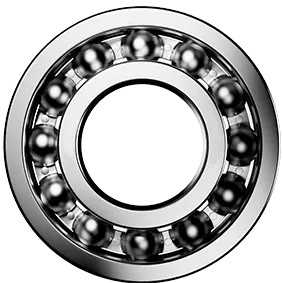
Second deep groove ball bearing
Structurally, each ring of a deep groove ball bearing has a continuous groove type raceway with a cross-section approximately one-third of the equatorial circumference of the ball. Deep groove ball bearings are mainly used to withstand radial loads and can also withstand certain axial loads. When the radial clearance of rolling bearings increases, they have the properties of angular contact ball bearings and can withstand alternating axial loads in two directions. Compared with other types of bearings of the same size, this type of bearing has a lower friction coefficient, higher maximum speed, and higher accuracy, making it the preferred bearing type for users when selecting. Deep groove ball bearings have a simple structure and are easy to use. They are a type of bearing with the largest production batch and a wide range of applications.
Third thrust tapered roller bearing
Due to the fact that the rolling elements in thrust tapered roller bearings are tapered rollers, the rolling generatrix and the raceway generatrix of the washer intersect at a certain point on the axis of the bearing, so the rolling surface can form pure rolling and the ultimate speed is higher than that of thrust cylindrical roller bearings. Features: Thrust tapered roller bearings can withstand unidirectional axial loads. The type code for thrust tapered roller bearings is 90000.
Structure and performance characteristics of the fourth double row tapered roller bearing
There are various structures of double row tapered roller bearings, with a large number being the 35000 type, which has a double raceway outer ring and two inner rings. There is a spacer between the two inner rings, and the clearance can be adjusted by changing the thickness of the spacer. This type of bearing can withstand both radial and axial loads in both directions, and can limit the axial displacement of the shaft and housing within the axial clearance range of the bearing. The structural characteristics of tapered roller bearings. The type code for tapered roller bearings is 30000, and tapered roller bearings are separable bearings. Conical roller bearings are mainly used to withstand combined radial and axial loads, mainly radial loads. Compared with angular contact ball bearings, it has a higher load-bearing capacity and lower limit speed. Conical roller bearings can withstand axial loads in one direction and limit axial displacement of the shaft or housing in one direction.
During the operation of rolling bearings, due to external or internal factors, the original fit clearance changes, the accuracy decreases, and even causes "biting", which is called clearance change failure. External factors such as excessive interference fit, improper installation, expansion caused by temperature rise, instantaneous overload, and internal factors such as residual austenite and residual stress in a stable state are the main reasons for the failure of clearance changes.
The anti rust oil coated on the bearing has good lubrication performance, and for general purpose bearings or bearings filled with lubricating grease, it can be used directly without cleaning. But for instrument bearings or bearings used for high-speed rotation, clean cleaning oil should be used to wash away the rust proof oil. At this time, the bearings are prone to rusting and should not be left for a long time.
Clean the bearings and housing to confirm that there are no scratches or burrs left by mechanical processing. There must be no abrasives (SiC, Al2O3, etc.), molding sand, chips, etc. inside the shell.
The manufacturing of rolling bearings generally involves multiple processing steps such as casting, heat treatment, turning, grinding, and assembly. The fairness, advancement, and stability of various processing techniques can also affect the lifespan of bearings. The heat treatment and grinding processes that affect the quality of finished bearings are often more directly related to bearing failure. In recent years, research on the deteriorated layer on the working surface of bearings has shown that the relationship between grinding technology and bearing surface quality is closely related.



 Contact Email




 Company News